English
English
Lead qualification in chat: the AI asks what matters, collects contact details and tags hot prospects, so your team only greets people ready to buy.
Tuesday morning, three people write almost the same message to a solar panel vendor: "How much does it cost to install solar panels?"
The first is a student working on an assignment. The second is a homeowner whose electricity bill is giving them headaches. The third is a factory manager drafting next year's budget. Three messages, one sentence, three different worlds. And your salesperson, who has exactly one morning, replies to all three with the same brochure.
Here's our view: lead qualification isn't about turning people away. It's about making sure expensive human time goes to the conversations that can actually become a purchase, while questions that can answer themselves, do. And the asking part is the job an AI suits best, because an AI doesn't get bored asking the same thing for the fiftieth time.
Lead qualification means sorting prospects: who's serious, who's still browsing, who needs a person's attention today. Sales has plenty of frameworks, like BANT (budget, authority, need, timing). The core is always the same four simple questions, in order:
On WhatsApp, those four usually get dug out over six tiring rounds of back-and-forth. That's what we wanted to compress.
The example is an invented business, Surya Teduh Energi, a solar panel vendor. It isn't a customer story.
The AI answers and asks. The first question, like "can you survey the roof first?", is answered from your knowledge. You can also teach the AI its asking habits through Instructions under AI › Personality, for example "ask for the rough electricity bill and location before offering a package", and by writing your question flow into Sources. The guide is the AI personality.
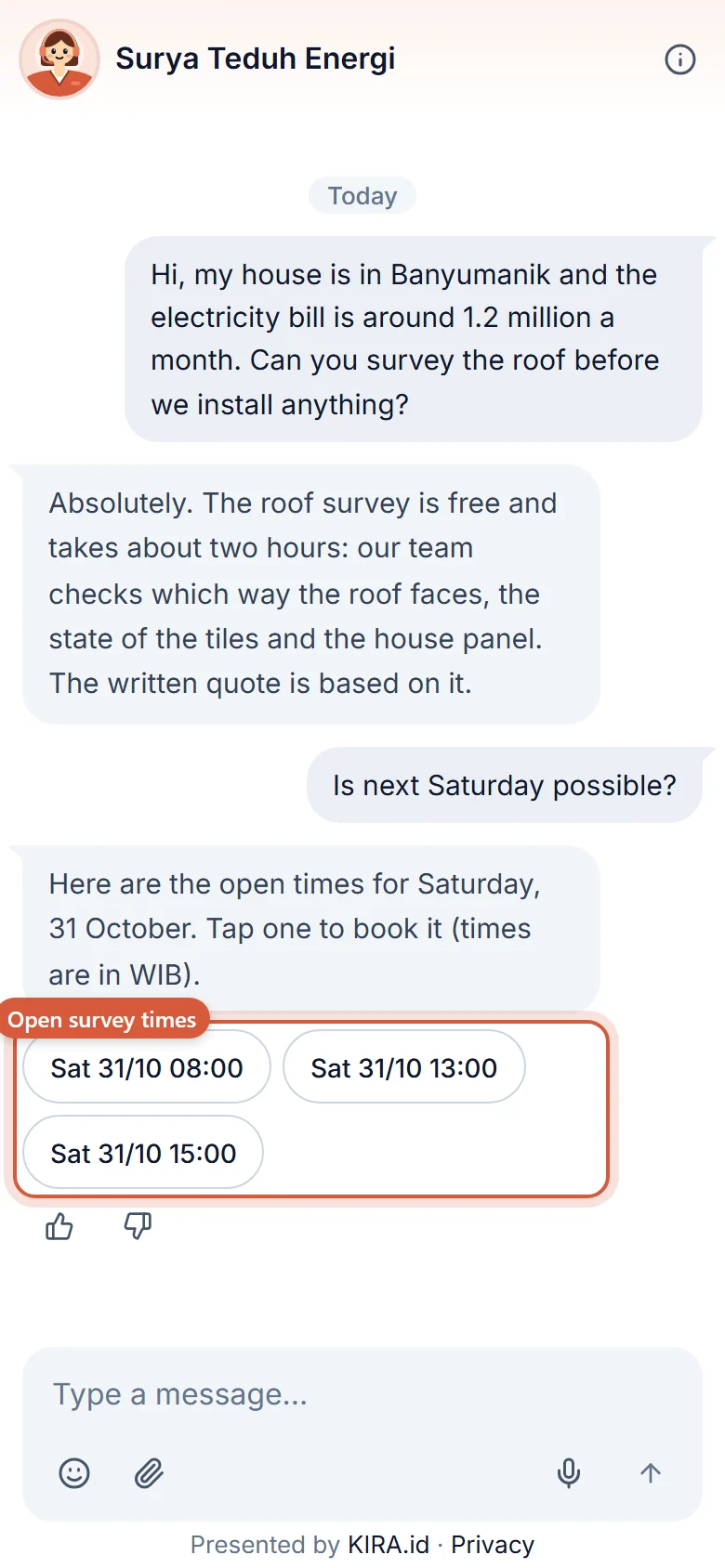
Details are collected once, on one card. With the Send a short form tool switched on under Settings › AI, the AI asks for several details at once in a single form, not a string of questions. Only details that will actually be used are asked. See forms in chat.
Contact is asked for politely. The contact card asks for a WhatsApp number first, then an email, and both are optional:
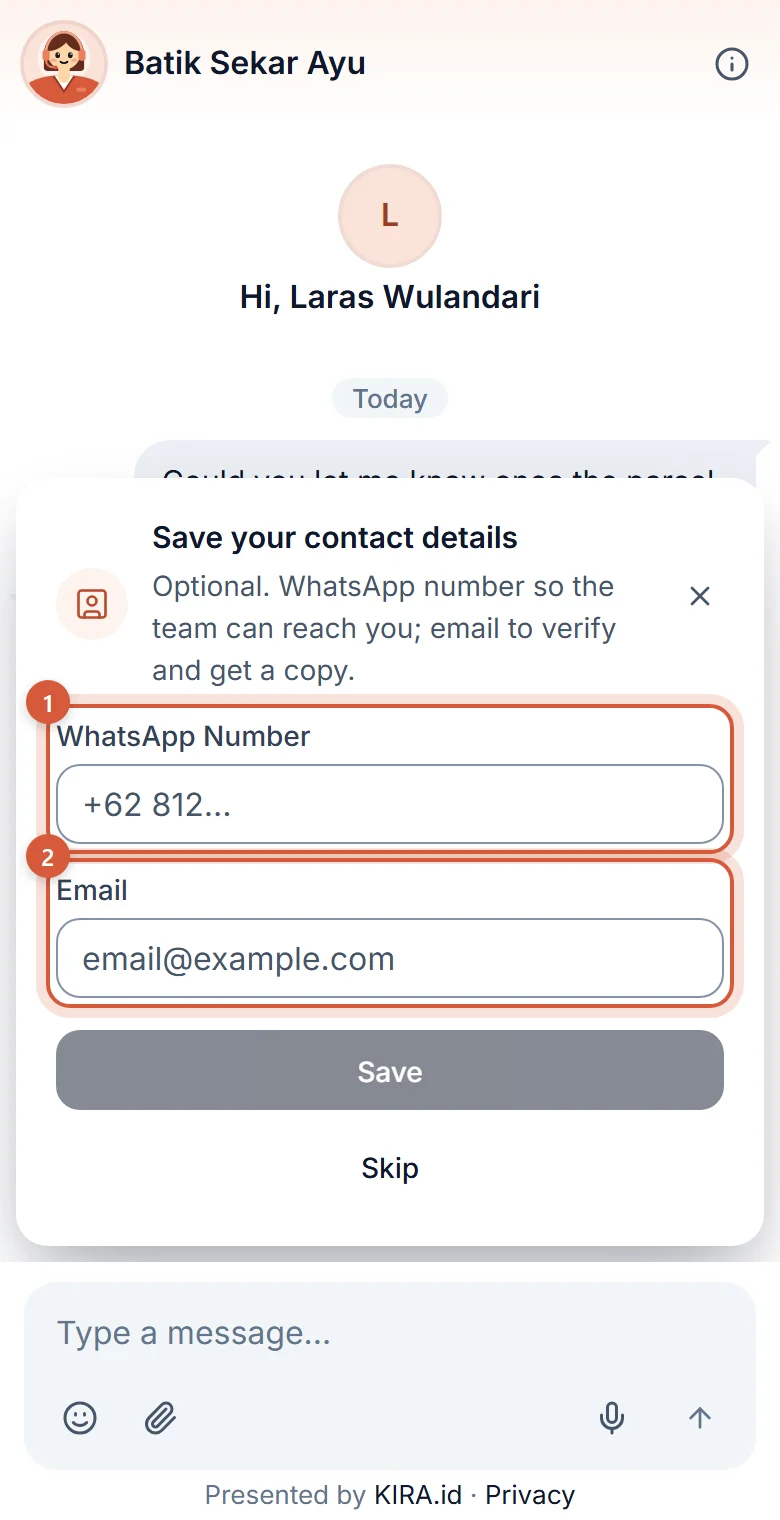
The AI asks once, and a customer who declines isn't pushed. A typed number is still noted but isn't treated as verified; why, and what the difference means, is in typed and verified contacts.
Those ready to buy get tagged. A customer who says they want to buy, asks for a quote or asks for an invoice is read by the AI as Ready to buy, gets the Hot lead tag, and your team is told once. The AI keeps the chat and helps the buyer from your knowledge until you say hello. The full rules are in handoff rules.
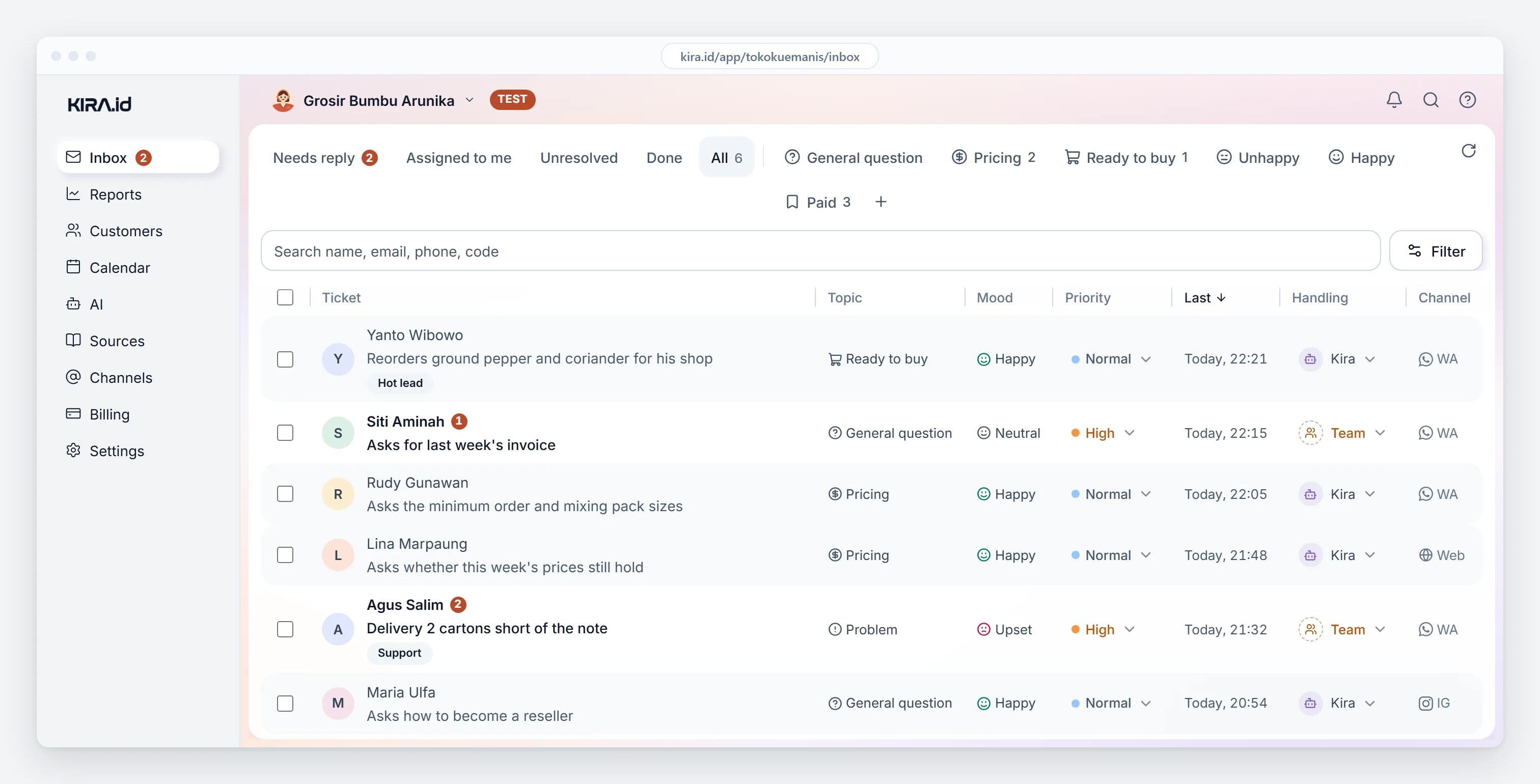
Finally, every ticket carries a short Summary in the right panel, so sales opens the conversation without reading twenty messages first. And under Reports › Overview, the Customers who want to buy are waiting card appears when customers who came to buy haven't had a reply, with their real chats and a Reply to these customers button.
We don't want to overstate it, so here are the limits:
| There | Not there |
|---|---|
| The AI asks according to the Instructions you write | Automatic lead scores |
| A Hot lead tag for those ready to buy | Sales stages (a pipeline) and a deal board |
| Ticket summaries and conversation history | A self-calculated "qualified" label |
| Verified contacts, without pushing | A task list for sales |
If your sales team needs a full pipeline, KIRA.id isn't that, and we won't pretend. What we do is the earliest, most tiring part: answering, asking, and sending the right person to the right person.
A solar vendor. Home questions (roof survey, scheduling) are answered and scheduled in the chat. Factory questions, like capacity and operating hours, are collected in one form, then passed to your team. The longer story is in industrial solar EPC.
A wholesale spice distributor. A buyer asking "what's the minimum order in cartons?" is answered from the table. One who says "okay, ten cartons" is tagged Hot lead.
A corporate outbound package provider. The AI asks for group size and rough dates, then passes the chat to your team for a quote.
Related reading: your best leads are already messaging you and collecting contact details inside the chat.
What is lead qualification? Sorting prospects to learn who's serious and should be greeted by a person first, usually through a few questions about need, scale, timing and the decision maker.
Does KIRA.id qualify leads automatically? The AI asks according to the instructions you write and tags buyers who are ready as Hot lead. KIRA.id doesn't give lead scores or sales stages.
How do I handle lots of WhatsApp leads? Let general questions answer themselves, collect details once on a card, and have your team greet only those tagged as ready.
Does the AI force customers to share their number? No. The contact card is optional, the AI asks once, and a customer who skips isn't asked again.
Asking the same question for the fiftieth time shouldn't drain your salesperson's energy. If you'd like to see this flow in your business, get in touch, or read the handoff rules first.