English
English
Customer service training for a new chat admin: the five topics that matter, a five-day plan in one table, role-play cards, and how AI shortens the learning curve.
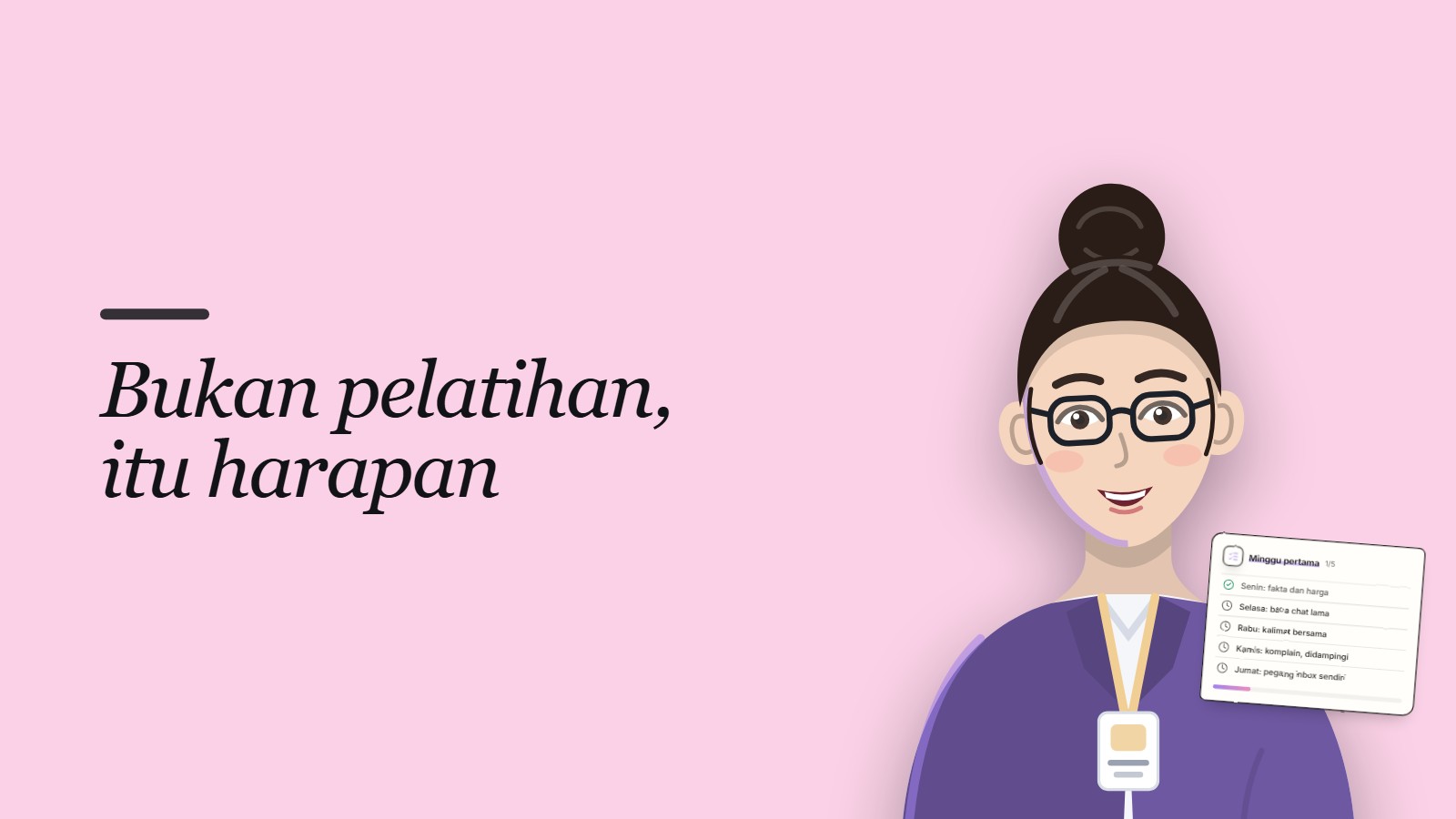
The most useful customer service training for a small business is a planned first week: facts on day one, old chats on day two, shared wording on day three, complaints with a mentor on day four, and the inbox alone on day five. It covers five topics: products and policies, writing in chat, handling upset people, knowing when to escalate, and the tools. Certified courses help, but only after that.
Monday morning. Your new admin arrives on time, neat, keen. You hand over the shop phone, WhatsApp Business already signed in, and one sentence: "Have a look around, ask if you get stuck." By eleven they've quoted a customer the wrong shipping fee, and you only find out because the customer tells you.
That isn't training. That's hope. Our view: customer service training rarely fails because the new hire isn't smart enough. It fails because the owner never wrote down what's in their head. Once the written part exists, five days is enough to let a new admin work alone, and outside courses simply sharpen what's there.
This post is for owners about to train their first, or next, chat admin. What to look for when hiring is covered in customer service duties and skills; here we pick up the day after they say yes.
Customer service training is a planned process that gets someone serving customers to your standard: correct answers, the right tone, and knowing when to call someone else. It comes in two forms, and neither replaces the other.
Note the words according to the SOP. Every course assumes the SOP exists, and in a small business it often lives only in the owner's head. So: write it down, train in-house, then add a course if it's worth it.
A chat admin needs five topics: product and policy facts, writing in chat, handling upset customers, the limits of their authority, and the tools. Everything else (closing techniques, retention, KPI jargon) can wait until these five are solid.
| Topic | What they practise | Training material | How you know they've got it |
|---|---|---|---|
| Product and policy facts | Prices, variants, shipping, opening hours, returns, payment | Price list, FAQ, written policies | They answer the ten most common questions without asking you |
| Writing in chat | Short, warm, one question one answer, a consistent greeting | Five old chats that were handled well | Replies are two or three sentences and need no tone fixes |
| Upset customers | Naming the problem, not getting defensive, giving the next step | Three past complaints, names removed | Their first reply doesn't contain the word "but" |
| Limits of authority | What they can decide alone, what goes to the owner | A one-page list: refunds, discounts, exceptions | They say "let me check with the owner" at the right moment |
| Tools | Inbox, labels, internal notes, saved answers, shift handover | Their own login, not a shared phone | They write a handover note without being asked |
One thing is left out on purpose: "fast replies". Speed arrives on its own once the facts and the wording are in hand. Training speed before accuracy just gets wrong answers sent sooner.
A good first-week plan has one goal a day, one result you can check each afternoon, and a share of real chats that grows every day. Here's the version we'd suggest for a small business with one or two admins:
| Day | Goal | Activity | What you check that afternoon | Real chats |
|---|---|---|---|---|
| Monday | Know the facts | Read the price list, FAQ and policies; note what's unclear | A list of questions your documents don't answer | None yet |
| Tuesday | Meet the customers | Read 20 past conversations: 10 smooth, 10 messy | Three patterns they spotted themselves | Reading only |
| Wednesday | Shared wording | Draft replies for recurring situations; you edit | Five to ten agreed saved answers | Simple questions, you read before sending |
| Thursday | Complaints and authority | Complaint role-play, then real complaints with you beside them | One complaint reply you discussed together | Most chats, complaints mentored |
| Friday | On their own | Run the inbox, write handover notes | Their best chat and their hardest, read together | All of them, you're backup |
Two small rules make it work. Monday's list is a gift: every question they find is a hole your customers will find too, so fill it that day. And Friday's review starts with their best chat, not their mistakes. An admin who feels safe asks more in week two.
The role-plays worth doing use real customer messages from your own chat history, rewritten without names, not made-up scenarios from a textbook. You play the customer, they type a reply, then you read it together. Eight cards we suggest almost every time:
| Situation | Customer message (example) | What you're judging |
|---|---|---|
| Price and stock | "Is the black one in L still available? How much?" | Correct facts, one nudge to the next step |
| A question your documents don't cover | "Can you ship to Timor-Leste?" | They don't invent; they say they'll check |
| Late order | "Why hasn't it arrived? You said yesterday." | Acknowledge, give the status, promise an update with a time |
| Damaged item | "One of the glasses is broken." | Asks for a photo politely, doesn't blame the courier to the customer |
| Discount request | "Can you do a better price if I take two?" | Knows the limit of their authority |
| Rude customer | "Your admin is so slow, do you even want to sell?" | Stays calm, doesn't match the tone, goes straight to the fix |
| After hours | A message at 11:40 pm | Knows what's handled automatically and what waits for morning |
| Regular customer | "The usual, please." | Reads the history before asking again |
The second card matters most. An admin who invents an answer in practice will invent one in front of customers.
AI and saved answers shorten training because they move knowledge out of your head and into a place the admin can read any time, without interrupting you. A new admin doesn't need to memorise everything on day one; they need to know where the answer is written.
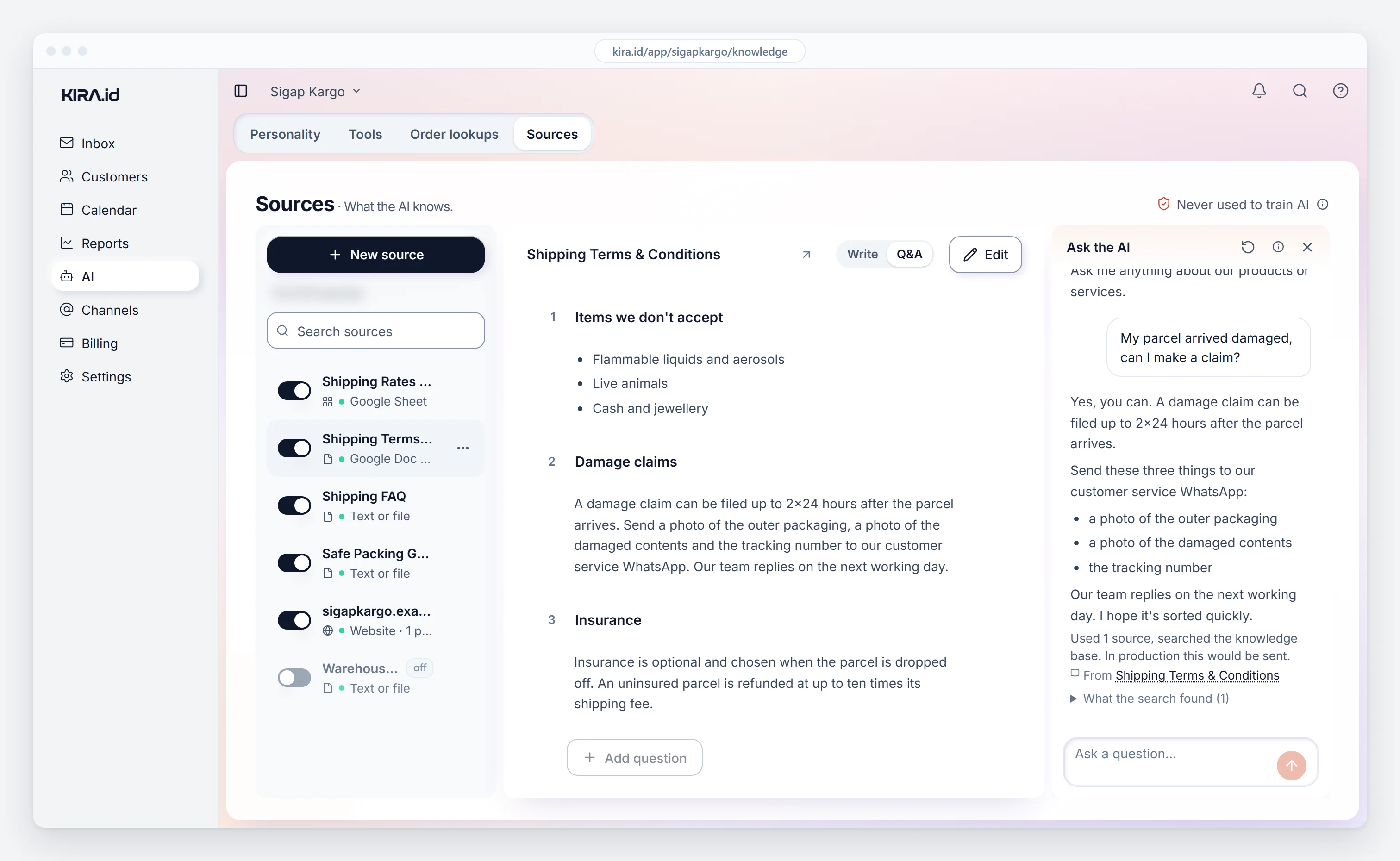
In KIRA.id, an Indonesian AI customer service platform for WhatsApp, Instagram, Messenger and web chat, the same documents get used twice. The AI answers customers only from the sources you add (your website, PDFs, Google Docs and Sheets, FAQs), and your new admin learns from those same sources through the Ask the AI panel. They type a question the way a customer would and see the answer along with the source it came from. The Agent role can ask too, even though it can't edit sources (the Ask the AI panel).
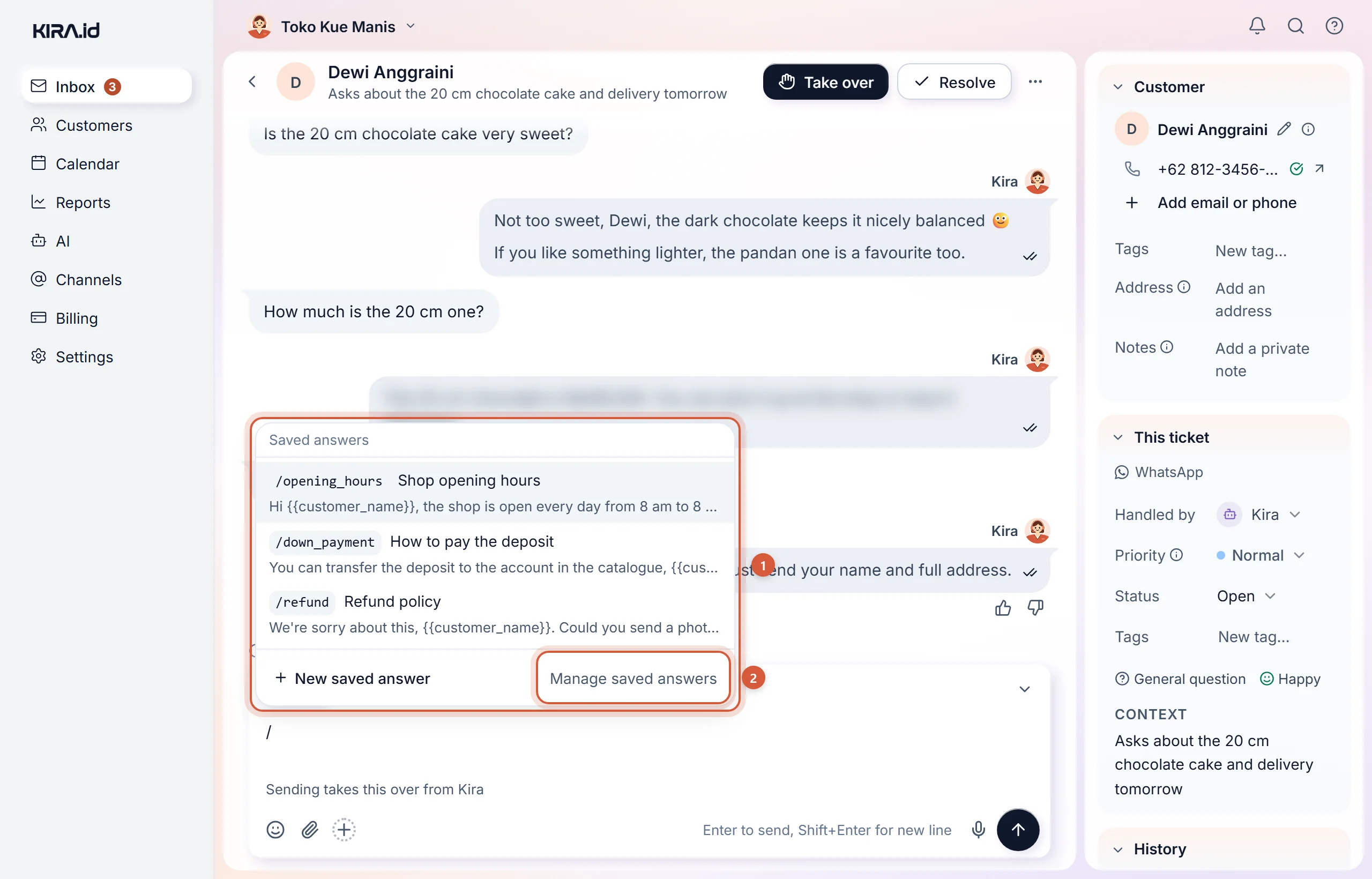
Wednesday's output, the agreed wording, becomes Saved answers. The admin types / in the reply box, picks the line, and the customer's name fills itself in when the line uses the Customer name marker. They still read the full text before sending, and only an Owner or Admin can change it, so a bank account number never ends up one digit off from being retyped (saved answers).
And since the AI already answers repeat questions ("are you open?"), your new admin learns on the tickets that actually reach the team, taking over a conversation and handing it back when done. Invite them as an Agent, not an Admin: they can reply to every chat but can't change settings (roles and permissions, and our reasoning in roles for a small team).
The honest limit: AI doesn't teach empathy, and it doesn't decide refunds. You still run the rude-customer card yourself. And keep team-only rules, like special discounts, out of the AI's sources: anything there can be told to customers.
If you're curious, you can try it yourself in about a minute, with no card, no demo and no sales call: sign in with Google, type your business name, add one web page or FAQ, then ask a question in Test AI. The full setup, WhatsApp connected, takes about five minutes (the five-minute setup).
For a chat admin in a small business, start with in-house training, add online courses for general skills, and consider a certified class only when the role genuinely needs proof of competence. Side by side:
| In-house training | Online course | Certified class (e.g. BNSP) | |
|---|---|---|---|
| What they learn | Your products, customers and rules | Communication and service in general | A standard, tested set of competencies |
| Usable this week | Yes | Partly | Partly |
| Needs your written SOP | Yes, that's the point | No | No, but they'll ask about it |
| Best for | Every new admin | Admins who want to grow | Employers who require a certificate |
No outside course knows that shipping to Medan went up last month. Only your documents do.
Customer service training has worked when, by the end of week one, your new admin answers routine questions without asking, admits what they don't know instead of inventing, and passes anything beyond their authority to the right person. Check with three questions on Friday:
Numbers like waiting time and satisfaction come after two or three weeks. To keep your documents whole after week one, use the weekly knowledge gap routine.
The basics take five working days if your facts and policies are written down. A feel for regular customers and special cases grows over the following weeks.
Five core topics: product and policy facts, writing in chat, handling upset customers, the limits of their authority, and tools such as the inbox and saved answers.
There are free online courses and government programs; in Indonesia, Kemnaker's training catalogue lists them. Requirements, schedules and costs differ by program, so check there directly. Your own first-week training is free and the most relevant of all.
For a small business, usually not. A certificate helps when a role requires proof of competence or the admin wants to build a career. It doesn't replace training on your own products.
No. AI takes the repeat questions and gives the admin a place to look up written answers, so training gets shorter. Empathy, judgement and anything involving money still have to be trained and handled by people.
KIRA.id is an AI customer service platform for businesses in Indonesia that answers customers on WhatsApp, Instagram, Messenger and web chat from the business's own knowledge, and hands over to the team when a person is needed. More on the about KIRA.id page.
Tonight, before your new admin arrives, write down the ten questions you get most often, with their answers. That's Monday's material, Wednesday's saved answers and your AI's first source, all at once. To set up the account and sources, follow your first hour with KIRA.id and the Ask the AI panel guide. If you'd like help planning that first week, talk to us.