English
English
A freight forwarder in Indonesia loses leads at the weekend. The AI answers services and documents, collects shipment details and tags hot leads for sales.

Monday, 8:15 am. A sales admin at a freight forwarder in Indonesia, based in North Jakarta, opens the office WhatsApp while waiting for the coffee to cool. Between group chats and invoices sits one message from Saturday at 7:40 pm: "Hi, I want to import a machine from Guangzhou, one 20-foot container, can you do door to door to Bekasi? The goods are ready next week."
She replies with real enthusiasm. Five minutes later the answer comes back: "Thanks, but we found another forwarder yesterday."
It feels like a door shutting right in front of your face. And the most annoying part is that the question was easy. Door to door to Bekasi is something they do. The documents are listed in the brochure. All that was missing was someone to answer on a Saturday night.
Our view: for a freight forwarder in Indonesia, the first reply isn't customer service. It's sales. An importer who asks at the weekend usually picks whichever forwarder answers at the weekend. You don't have to work out a quote at 7:40 pm. You only have to make that person feel looked after, and make sure your team knows exactly whom to call first thing in the morning.
Forwarder leads come from everywhere: ads, the website, referrals, Instagram. Most of them end up in WhatsApp, and WhatsApp can't tell an importer ready to ship a container from someone who's just curious. Each one is a single row in the chat list, sinking under the next message.
Then there's a second problem: the opening questions are nearly always the same. Which cities, door to door or port to port, FCL or LCL, which documents, how long. A salesperson answering those over and over is a salesperson with no time to call the leads who are already serious.
In KIRA.id you write down your forwarding knowledge: routes (China to Indonesia, say, or export and import lanes to particular countries), service types, required documents, goods you won't handle, typical transit times, and how to request a quote. The AI answers from that, in the language the person writes in. A supplier or buyer writing in English is answered in English.
When someone wants a quote, the AI asks for the shipment details in one go through a form (if Send a short form is on and you've written the flow): port of origin, destination, type of goods, volume or weight, number of containers, and ready date. On WhatsApp the questions arrive as lines of text. See Forms in the chat.
Then the AI tags the chat.
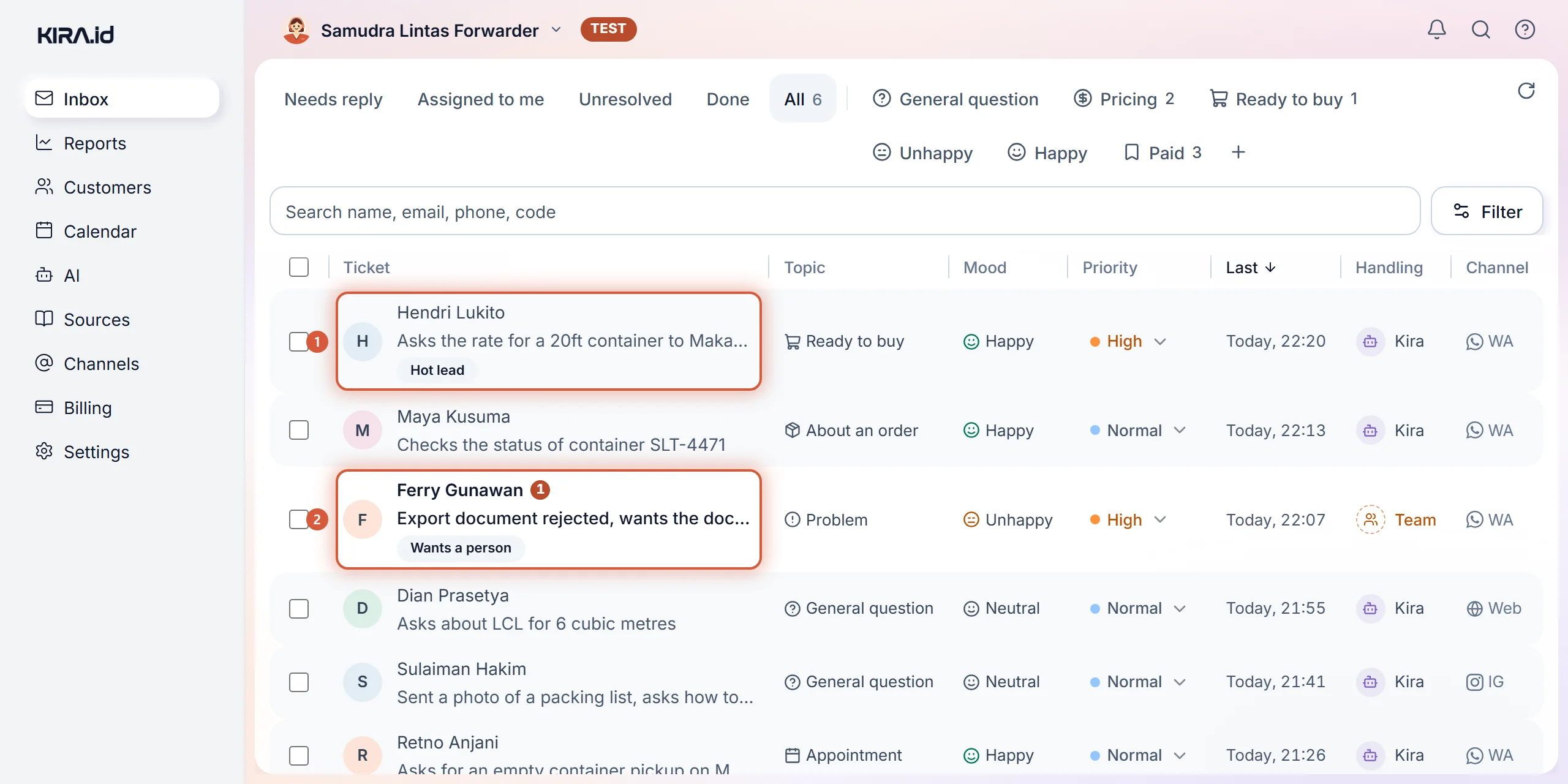
Look at the first row of this invented forwarder inbox: a prospect asking for the rate on one 20ft container has the Hot lead tag. The team is notified once, and the AI keeps answering their questions in the meantime. In the morning, sales doesn't open every chat one by one. They tap the Ready to buy chip, see the Hot lead tag on each row, and call the most ready people first. The rules are in Handoff rules.
What sales still does: the price quote. Freight rates move, and the AI doesn't make up figures that aren't in your sources. If you have a rate table you actually publish (LCL rates per CBM for certain lanes, for example), the AI can quote it exactly. If not, the AI says the team will send the quote.
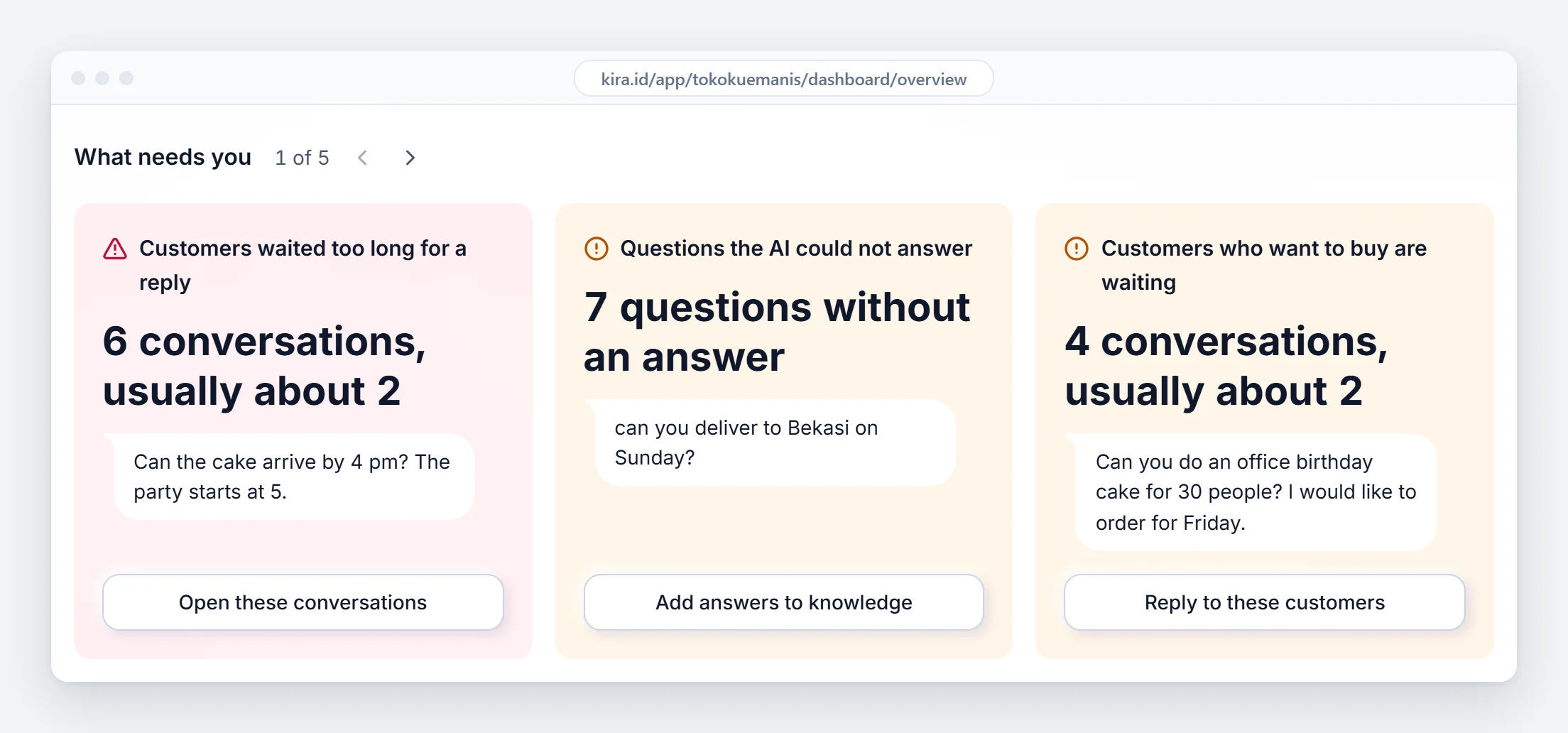
This page comes from an invented cake shop, but for a forwarder it's just as valuable. Reports › Overview puts whatever is unusual on cards, and every Monday adds the lanes and services people asked about most. The Customers who want to buy are waiting card holds the people who asked for a rate and haven't had a reply, with a Reply to these customers button. That's your Monday reply list. The Questions the AI could not answer card tells you which lanes or documents you haven't written up yet. See What needs you.
For the person who says "I'll check with my manager first", KIRA.id can send one short follow-up after the pause you set, and only when something is genuinely pending. Not "Hi, are you still there?" over and over. See Following up quiet customers.
| Sales replies to every chat | KIRA.id answers first | |
|---|---|---|
| A Saturday-night question | Waits until Monday | Answered from your knowledge |
| Basic questions (lanes, documents, services) | Repeated every day | Answered by the AI, exactly as you wrote them |
| Shipment details for a quote | Asked one by one | One form |
| A serious lead | Lost in the chat list | Hot lead tag, team notified once |
| The price quote | Sales | Still sales |
| A lead nobody answered | Forgotten | On the Customers who want to buy are waiting card |
| Pipeline and deal stages | In the sales spreadsheet | None: KIRA.id isn't a sales CRM |
With an AI that answers from your service knowledge, collects shipment details and tags the serious leads. Sales follows up during working hours.
Only from rates you've written in your sources. A quote that needs calculating is still sent by the team.
The AI replies in the language the person writes in, from sources you wrote. The system's automatic lines, such as the notice that the reply will come in this chat, exist in Indonesian and English only.
No. KIRA.id answers and tags leads in the chat. The sales pipeline stays in your sales tools.
Start with one services FAQ page and one quote request flow. Also read China import services in chat, slow replies that lose sales, and cargo quotes through a form in the chat. Want to see it with your own lanes? Get in touch.