English
English
Customer service statistics for Indonesia in 2026 from primary sources: internet and social media users, reply-time expectations, AI adoption and small business. Every number links to its publisher and year.
In 2026 Indonesia has 235 million internet users according to APJII, and customers everywhere expect fast replies: 90% rate an immediate response as important when they have a service issue, according to HubSpot research. This page collects the customer service statistics that matter for Indonesia, grouped by theme. Every number links to its original source, with publisher and year, and was rechecked in October 2026.
We built this page out of irritation. Search for customer service statistics about Indonesia and you get translated foreign pages, numbers with no link, or numbers that link to another blog that links to nothing. A number you can't check isn't data. It's a well-formatted rumour.
So the rule is simple: we read every number here at its source ourselves. Anything we couldn't find at the original source is left out, however often it gets repeated elsewhere.
About four in five Indonesians are online: APJII counted 235 million internet users in 2026, a penetration rate of 81.72%. Your customers can, almost certainly, write to your business, and they'd rather do that than wait.
| Figure | Data | Source |
|---|---|---|
| Internet users in Indonesia | 235 million (2026), 229 million (2025), 221 million (2024) | APJII, Survei Internet APJII 2026 |
| Internet penetration | 81.72% (2026), up from 80.66% (2025) and 79.50% (2024) | APJII, Survei Internet APJII 2026 |
| Internet users, October 2025 | 230 million, 80.5% of the population | DataReportal (Kepios), Digital 2026 Indonesia, published late 2025 |
| Social media user identities | 180 million, 62.9% of the population (October 2025) | DataReportal, Digital 2026 Indonesia |
| Active cellular connections | 331 million, equal to 116% of the population (end of 2025) | DataReportal, Digital 2026 Indonesia, GSMA Intelligence data |
| Instagram ad reach | 108 million users (late 2025) | DataReportal, Digital 2026 Indonesia, from Meta's ad tools |
| Facebook ad reach | 121 million users (late 2025) | DataReportal, Digital 2026 Indonesia, from Meta's ad tools |
| Messenger ad reach | 33.7 million users (late 2025) | DataReportal, Digital 2026 Indonesia, from Meta's ad tools |
Two notes so these don't get misused. First, APJII and DataReportal use different methods, so 235 million and 230 million don't contradict each other. Second, DataReportal itself warns that "social media user identities" may not equal unique people, and platforms can correct their ad-reach figures.
WhatsApp is where small businesses work: Meta says 200 million businesses around the world rely on the WhatsApp Business app. Meta doesn't publish an Indonesia-only figure on any page we could check.
| Figure | Data | Source |
|---|---|---|
| Businesses relying on the WhatsApp Business app | 200 million, worldwide | Meta, Conversations 2025, July 2025 |
| Daily visitors to WhatsApp's Updates tab | 1.5 billion people | Meta, Conversations 2025, July 2025 |
| WhatsApp monthly active users | More than 3 billion monthly actives worldwide | Meta, Q1 2025 earnings call, 30 April 2025 |
According to GWI's survey in the same DataReportal report, 90.8% of Indonesian internet users aged 16+ used WhatsApp in the past month (Q2 2025), the highest of any platform. The breakdown is in WhatsApp statistics Indonesia 2026.
Customers expect a reply within minutes: in HubSpot's research, 90% rated an immediate response as important or very important for a service issue, and "immediate" meant 10 minutes or less. We haven't found a published Indonesian survey asking the same question, so the figures below are global.
| Figure | Data | Source |
|---|---|---|
| Rate an immediate response important or very important (service issue) | 90% | HubSpot, page updated March 2025 |
| Rate an immediate response important or very important (sales or marketing question) | 82% | HubSpot, March 2025 |
| Expect a response within 10 minutes | Almost two thirds of buyers | HubSpot, March 2025 |
| Consumers who now expect 24/7 service because of AI | 74% | Zendesk, CX Trends 2026, November 2025 |
| Frustrated when they have to repeat information | 74% of consumers | Zendesk, CX Trends 2026 |
| Want agents to continue the conversation without backtracking | 81% of consumers | Zendesk, CX Trends 2026 |
| Say responsiveness and accurate resolution highly influence purchases | 86% of consumers | Zendesk, CX Trends 2026 |
| Would choose a company that takes text, images and video in one thread | 76% of consumers | Zendesk, CX Trends 2026 |
An honest warning: Zendesk's CX Trends 2026 survey ran in June 2025 across 22 countries (6,182 consumers and 5,115 business respondents), and Indonesia was not one of them. Malaysia, the Philippines, Singapore and Thailand were. Treat it as a picture of the region, not an Indonesian number.
Customers are still wary while businesses keep moving: Gartner found 64% of customers would prefer companies didn't use AI for customer service, yet in Indonesia 80% of users interact with AI tools every day according to e-Conomy SEA 2025.
| Figure | Data | Source |
|---|---|---|
| Customers who'd prefer companies didn't use AI for customer service | 64% (survey of 5,728 customers, December 2023) | Gartner, July 2024 |
| Would consider switching to a competitor if a company used AI for service | 53% | Gartner, July 2024 |
| Top concern about AI in customer service | It gets harder to reach a person | Gartner, July 2024 |
| Service leaders under pressure to adopt AI | 60% | Gartner, July 2024 |
| Consumers who expect an explanation for AI-made decisions | 95% | Zendesk, CX Trends 2026, November 2025 |
| Prediction: common service issues resolved by agentic AI without a person by 2029 | 80%, with operational costs down 30% | Gartner, March 2025 |
| Organisations using AI regularly in at least one business function | Nearly nine in ten respondents | McKinsey, The state of AI in 2026, August 2026 |
| Respondents whose organisations are scaling chatbots across the enterprise | 47% | McKinsey, The state of AI in 2026, August 2026 |
| Smaller organisations (under US$1 billion revenue) scaling AI agents | 22%, flat on last year | McKinsey, The state of AI in 2026, August 2026 |
| Users in Indonesia who interact with AI tools daily | 80%, second highest in Southeast Asia | Google, Temasek, Bain, e-Conomy SEA 2025, November 2025 |
| Users in Indonesia actively learning AI skills | 79% | e-Conomy SEA 2025, November 2025 |
That Gartner 64% gets used to scare people. Read on to the concerns: customers fear it'll be harder to reach a person, that jobs will go, and that AI will give wrong answers. That isn't a rejection of fast answers. It's a rejection of AI used as a wall.
Small businesses (UMKM) are most of Indonesia's economy: more than 64 million business units, over 60% of GDP and almost 97% of the workforce, according to the Coordinating Ministry for Economic Affairs. Most of them serve customers without a dedicated customer service team.
| Figure | Data | Source |
|---|---|---|
| Number of UMKM | More than 64 million business units | Coordinating Ministry for Economic Affairs (Kemenko Perekonomian), January 2025 |
| UMKM share of GDP | More than 60% | Kemenko Perekonomian, January 2025 |
| Workforce employed by UMKM | Almost 97% | Kemenko Perekonomian, January 2025 |
| UMKM share of exports | About 15.7% | Kemenko Perekonomian, January 2025 |
| UMKM registered in SIDT-UMKM | 30.19 million (as of 31 October 2025); most in West Java, 5.4 million | Ministry of UMKM (Kementerian UMKM), December 2025 |
| Indonesia's digital economy (GMV) | Close to US$100 billion in 2025, up 14% | e-Conomy SEA 2025, November 2025 |
| Indonesia's e-commerce (GMV) | US$71 billion in 2025 | e-Conomy SEA 2025, November 2025 |
Why two UMKM counts? The 64 million is the number of business units the government uses in policy. The 30.19 million is how many UMKM were registered in the ministry's single data system (SIDT-UMKM) by October 2025. Each is right for its own question; don't mix them.
It means your customers are online, want a reply within minutes, and fear most that AI becomes a wall between them and a person. Three things we'd do as a small business owner, based on the numbers above:
At KIRA.id, an Indonesian AI customer service platform for WhatsApp, Instagram, Messenger and web chat, that first step lives in the Speed tab under Reports: how long customers wait for your team, counted in business hours, with the longest waits as examples.
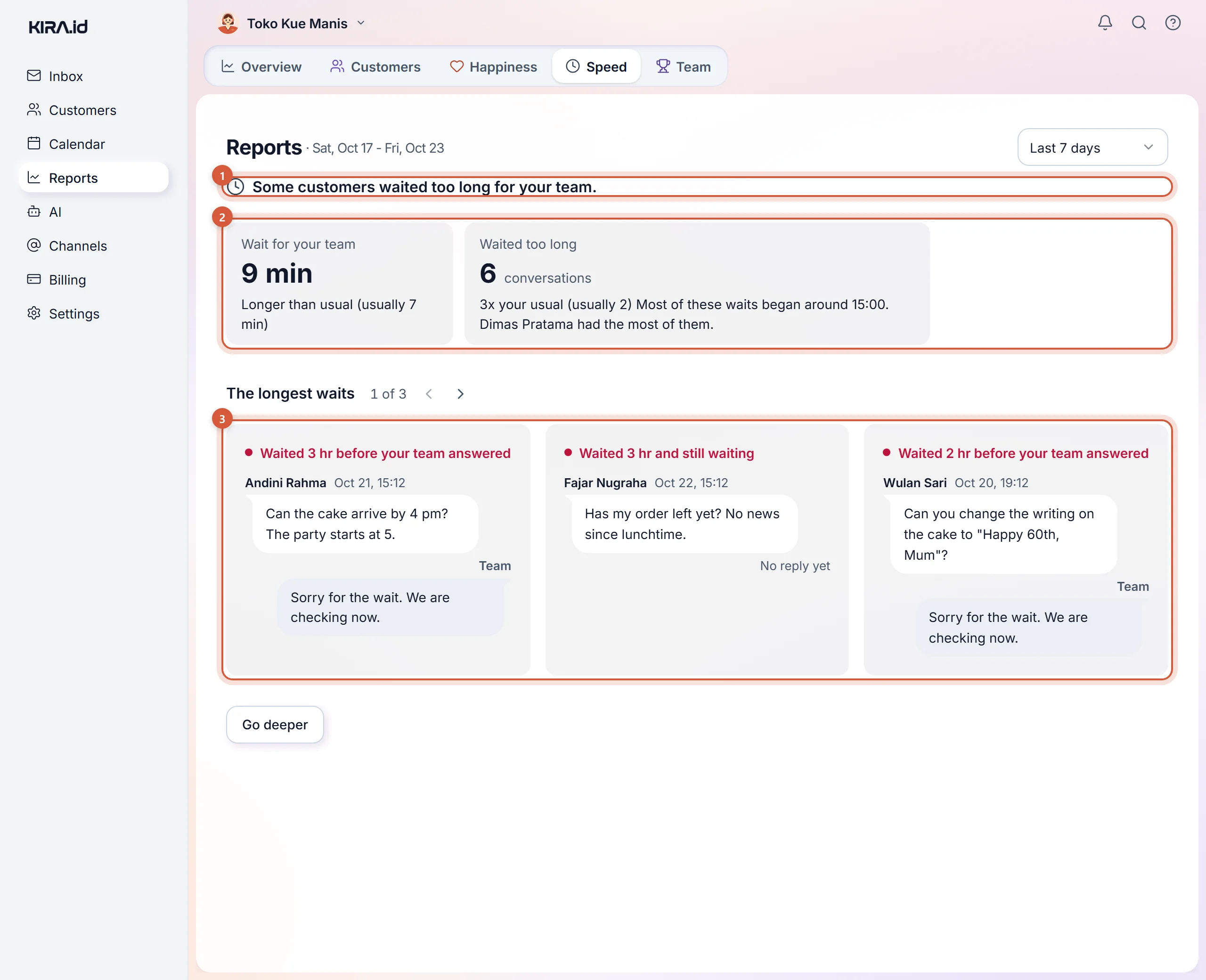
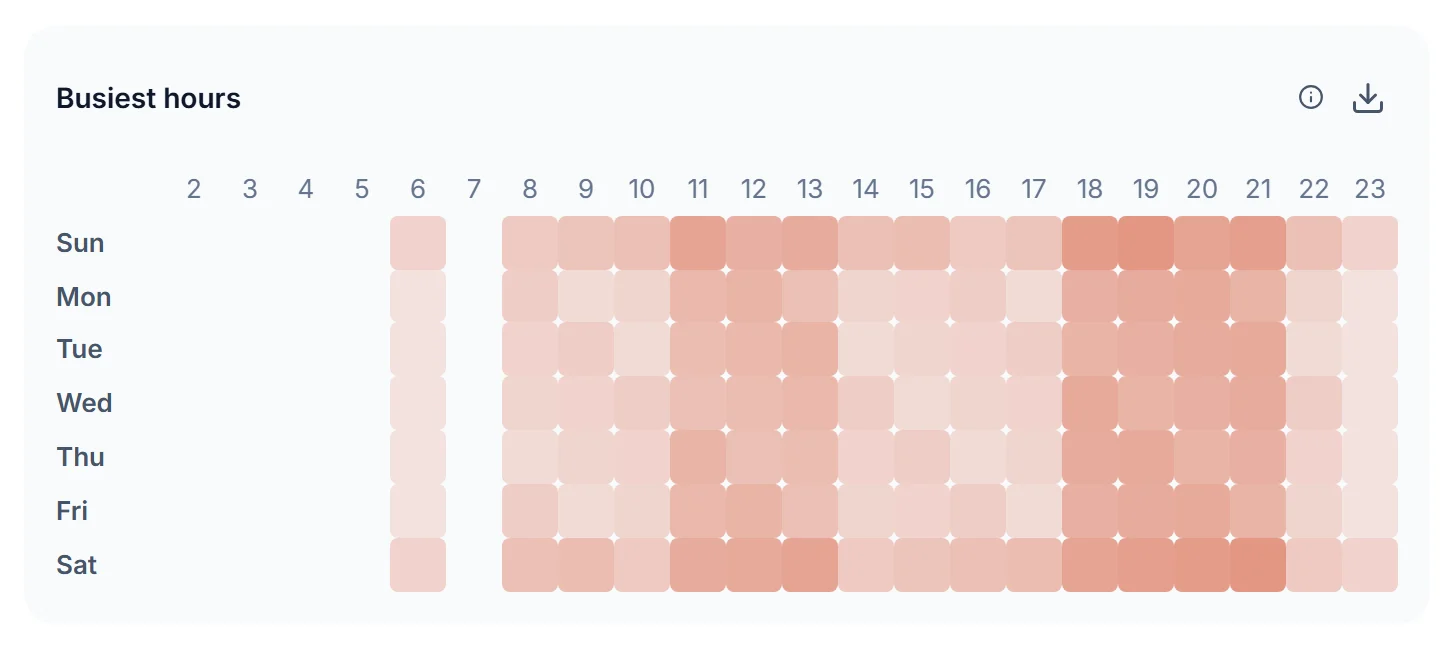
Then open Go deeper and read the Busiest hours map. If the darkest cells fall between 19:00 and 21:00, as in this example, that's when your customers write most, often after you've closed.
How to read both screens is in the Speed report and your team's reply speed guides. If your wait time turns out long, slow replies are losing you sales explains what usually happens next, and AI customer service cost vs an admin's salary helps you run the numbers. This year's big shifts are summed up in customer service trends 2026.
We recheck this page every quarter, and whenever one of its main sources publishes a new edition (DataReportal, APJII, Zendesk CX Trends, McKinsey, e-Conomy SEA). When a number changes, we replace it, name the new source year, and update the page's "updated" date.
Our rules:
Spotted a wrong number or a newer source? Tell us through the contact page and include the link.
According to APJII's 2026 internet survey, 235 million, a penetration rate of 81.72%. DataReportal counted 230 million in October 2025 using a different method.
HubSpot's global research says "immediate" means 10 minutes or less to customers, and 90% rate an immediate response as important for a service issue. We haven't found an Indonesian survey asking the same question.
We haven't found an Indonesia-specific survey on AI in customer service. What exists: 80% of users in Indonesia interact with AI tools daily (e-Conomy SEA 2025), while globally 64% of customers would prefer companies didn't use AI for service (Gartner, 2024), mostly for fear of not reaching a person.
More than 64 million business units according to the Coordinating Ministry for Economic Affairs (January 2025). The Ministry of UMKM had 30.19 million registered in SIDT-UMKM as of 31 October 2025.
Yes, and we'd be glad. Please cite the original sources we link too, because that's where the numbers come from.
National statistics give context; your own shop's numbers give decisions. Set your hours in Business hours so wait times are counted fairly, then read the Speed tab next week. Want to talk through your numbers with us? Get in touch.